For as long as I can remember, I've wanted to go to Mongolia. I don't know why - I don't think I grew up knowing someone who went to Mongolia (this is why I fell in love with Russia - a friend of my parents went in the 70s.), and it's not like Mongolia featured big in the movies in the 1980s. Maybe it was the horseback riding, I don't know. But it's been on my bucket list since having a bucket list was a thing to do (I started mine when I was 16.)
 |
| And we're off! |
So I decided to go, and I started my trip in Beijing, which I've blogged about previously, see
here if you want a refresher on my first week in Asia.
 |
| Dawn over the steppes |
Anyway - I arrived in UB on the Trans-Mongolia Train. I'd spent 27 hours with my travelling companion, Jason, and two Dutch guys who were sharing our tiny couchette. Thankfully, these guys were chill, and the trip passed quickly. A few times we headed to the dining car, just to give ourselves a bit of a break, and frequently we zoned out to music and books in our bunks. We watched the countryside slide by outside the windows - starting off as towering mountains near Beijing, and slowing giving way to rolling hills and farm land, to flat stretches with wind farms and not much else. Dawn came in a soft purple, pick and yellow, illuminating the Gobi desert as we tracked closer to UB. We saw the occasional Mongolia rider, and herds of camels (herds? trains? caravans? flocks? That makes them sound like birds.) but otherwise it was quiet.
We arrived at the train station in UB, and wonder of wonders - there is not only a place to change money (on the second floor of a building to your right as you walk away from the terminal), but on the first floor there is a booth where you can buy Movistar sim cards. This was great for us, until I realized that it wouldn't work in my phone. I had gotten a sim in Beijing that worked (plus I've had sims from several other countries that have all worked) but for some reason I couldn't get this sim to work.
Our taxi driver had trouble finding the hotel that the tour company we were using (
Intrepid) had booked. Very unhelpfully, the only address we had was written in the Latin alphabet, and Mongolian is written in Cyrillic. It took several phone calls, both the driver and Jason, to get better directions to the hotel.
After we checked in and dumped our luggage in our room, we headed out to find me a working sim card and a place to eat. UB is teeming with restaurants of all kinds - I saw at least two vegan restaurants, several Indian, Korean, and Japanese restaurants, as well as numerous British pubs and American steak houses. The bellboy at the hotel had marked the location of a cellphone shop on our map, so we headed there first, and with the help of a Mongolian-speaking woman from Florida (it's always Florida) I got a sim that worked with my phone! Finally, after a week, I had access to Facebook and Gmail and could let the world know that I was ok! (And fascinating in China.)
We headed to a Mongolian restaurant, Modern Nomads, that looked interesting. The decor inside would fit in in any trendy, upscale neighbourhood in Ottawa (*cough*Westboro*cough*) and the food was good. It was traditional Mongolian food, so we ordered a few plates to share. It was a gentle introduction to our fare for the next two weeks on our tour.
 |
| At our first ger camp |
Two mornings later we loaded up with the rest of the tour (whom we had met the night before, along with the guide) and headed out. I chose to ride in the van with the leopard print seat covers (because leopard print, and I was missing my cats) and my first thought was "Dear gods, I'm going to die in Mongolia" as the driver barrelled around other cars, weaving in and out of traffic and scaring the crap out of the tourists in the back. (It turns out that that's just the way he drives all the time, and after a few hours you just get really into it and start to egg him on.
The tour would follow the same pattern for the next 2 weeks: we would have breakfast at 7:15, if we were heading out that day, 8:00 if we were staying at that camp. Dinner was always at 7. When we were on the road, we would stop mid-morning for a pee break, as well as mid-afternoon. We would stop in a town somewhere along the way (usually mid-morning, occasionally this was our pee break), and we could stock up on snacks for the rides, as well as water and/or alcohol. We'd have lunch anywhere from 12:00 to 1:00, depending on if it was in a restaurant or if we were picnicking. The food also followed a theme - mutton (sheep meat!), potatoes, rice, and carrots, in some kind of combination. The food was good - it had flavour, it was filling, and it was tasty, but it got a little repetitive after a little while. Each ger camp has flush toilets, and running water. Most camps had hot water, although it did on occasion run out.
 |
| Amarbayasgalant Khiid |
We headed up first towards Amarbayasgalant Khiid, one of the top three Buddhist temples in Mongolia. We arrived at our ger camp to ominous skies. After throwing our things in our gers (two people per ger) we headed to the monastery, and did a tour of the buildings and the grounds, before trekking up a set up stairs built into the hill behind the monastery, to turn the multiple prayer wheels. From there, a small path lead over to another staircase, that rose to a giant, gold Buddha. It was completely different, yet the same to, the Lama Temple in Beijing. The elements were similar, but while the Lama Temple felt newer, more in use, this temple gave off a quieter vibe, as if it we had been transported back in time. This temple appeared to be used less, but with just as devout worshippers. We walked back to the vans, and drove back to the ger camp for dinner. We were lucky and missed the rain this day.
 |
| Amarbayasgalant Khiid from the hill |
The next day we were back on the road and drove north towards the Selenge River, with a stop off in Erdenet, for lunch and a quick visit to the carpet factory for some cashmere and, in my case, yarn. We stopped off at another ger camp, and our luck ran out - the rain started as we headed towards Uran Uul, an extinct volcano that we were to climb. The lot of us donned our rain gear, and set off up the slick path...that is, once the driver of the second van managed to get unstuck from the mud along the track road that led to the beginning of the trail.
 |
| storm off in the distance |
I reached the ovoo at top, and began a clockwise walk along the crater, when I saw flashes of lightening off in the distance. Used to the vistas at home (if you can see it, it can hit you) I sped up and jogged along the trail up top, hoping to reach the trail headed back down before the storm got any closer. This was my first lesson about Mongolia - the sky is so wide, and so open, that often you can watch storms rolling across the sky that are nowhere near you. This storm would hit us in earnest in about 3 hours, so I had lots of time. Because I was so quick to head back down the trail, I missed the double rainbow that the others saw by the time they made it up. Oh well, there's always another rainbow.
During dinner that night, we watched the storm from the restaurant's windows. The lightening jagged through the sky, and lit it up. The rain where we were had stopped at this point, so we thought the storm was moving off. In fact, it rolled closer and closer, and finally broke around 10:30, right over our camp. The thunder was so loud that it shook the ground, and rain pelted our gers. Thankfully, the felted wool of the ger is incredibly tight and waterproof, not to mention warm, so I fell asleep to the sound of the rain on the roof, thinking "this isn't anything like a tent."
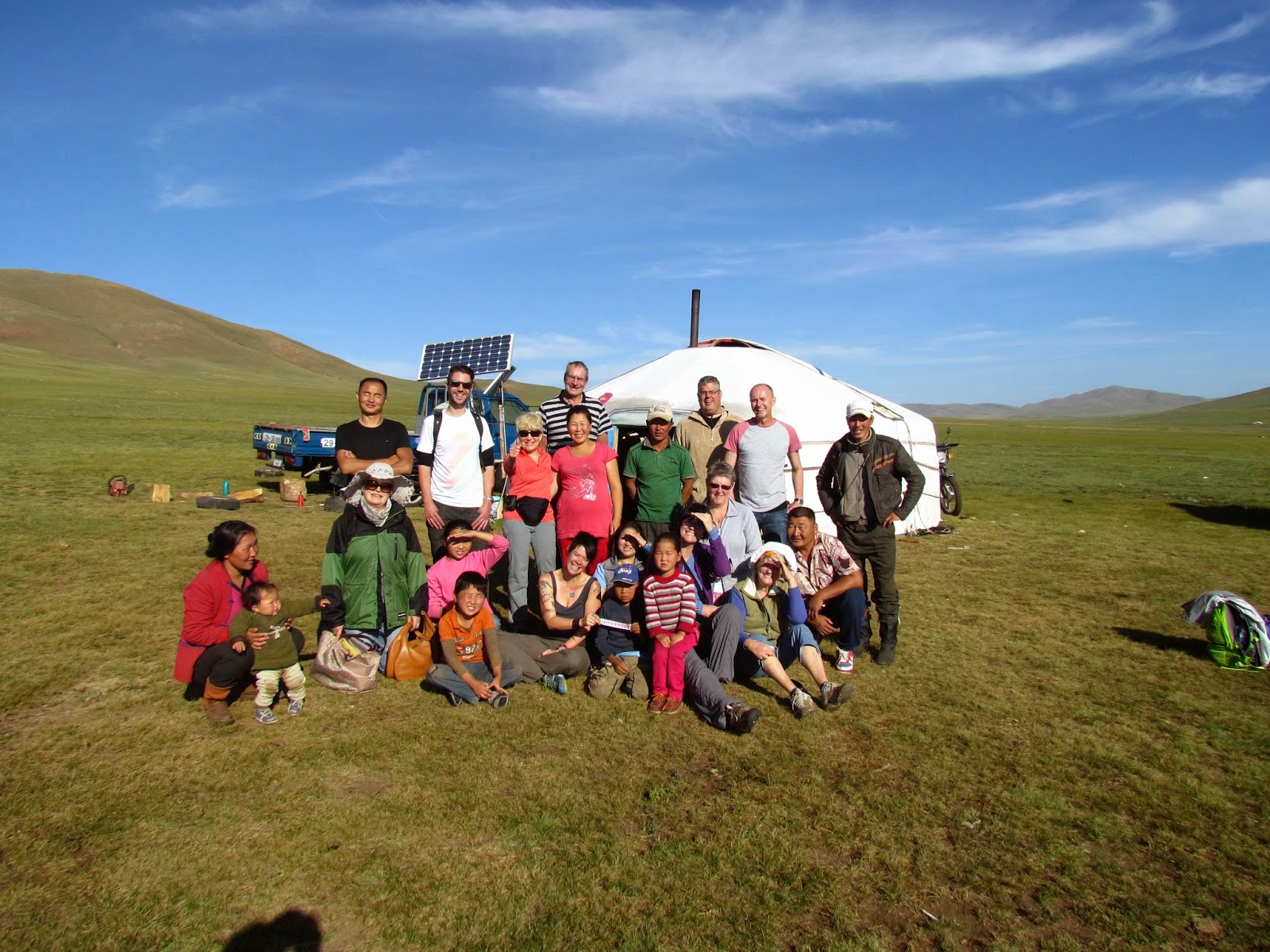 |
| At our first homestay - families, drivers and tourists |
The next day we went to visit a family, where we would stay for the night. We actually stayed with two, related, families who had gers close together. Half of us would sleep with one family, half with the other. When we arrived, the woman at the main ger was making internal organ soup - which she offered to let us taste, if we wanted to. Rather than bite into intestines or lungs, I decided to try to find the "toilet" - a ditch about a 10 minute walk from the ger. Having grown up camping, peeing outside is never an issue for me. Thankfully, the ditch added some privacy from the road; not that there was much traffic anyway.
 |
| Pointing at (beside) the peak we climbed |
We had some time to kill before dinner, so I hiked up the hills behind the gers, with two others from the tour. The grade was steep, and the ground was loose shale, with thin patches of grass in spots, so it was slow going. Then it steepened even more, and the lady with us decided to call it quits there and just enjoy the view. The guy and I pressed on, carefully as it would have been easy to lose our footing. We finally hit a small crest, and walked along a short ridge line to the rocky summit. The view was incredible - you could see gers dotting the landscape, sitting in valleys between the hills, and spread out in nearly every direction. There was little sign of human habitation - other than the white dots of the gers, one paved road and several dirt tracks, there was nothing. No cars hummed along the road, no motorbikes roared down the tracks, no hydro poles got in the way of a good photograph. We spent a while just soaking it all in before making our way back down to the ger camp.
 |
| View from up top |
 |
| My climbing partner while in Mongolia |
 |
| Setting up "camp" |
The other members of our group had spent the time reading, playing with the children, or visiting with the parents, with our tour guide as interpreter. After dinner, cooked by the guides, and on the urging of one of the other girls on the tour, she and I set up our bed rolls and sleeping bags on the group just outside the gers. The drivers helped us rig up mosquito netting, and we prepared to sleep outside under the stars. Besides our sleeping bags, I had a fleece, hat, long pants, and a sweater on....just in case. It was too bad the moon didn't cooperate - it was near full, and dominated the sky. No stars for us. However, it was great sleeping outside, on the steppes. We were both a little dew-soaked in the morning, so we hung our sleeping bags on the van doors to dry off while we had breakfast.
 |
| Lake Khovsgol |
That day we drove over the Selenge River taking a break by the river to take photos of the landscape, and stopped off in Mörön to pick up a picnic lunch and mail off any postcards we wanted to send. From there we headed north to Lake Khovsgol, stopping off at a small market set up by the reindeer herders, before heading down to the lake shore, and our ger camp.
We had two days to spend at Lake Khovsgol, and we planned to make the most of them. The first thing I did upon arrival was pack up some dirty clothes to have the staff launder for me - between Beijing, the train ride and the few days on the tour, I needed most things washed, if I wanted anyone to sit next to me at dinner. A few of us decided to walk along the shoreline, passing a few other ger camps, and families on the beach enjoying what we found out was an unseasonably warm day. I have to admit - I had expected the Mongolian temperatures (especially this far north) to be cooler, but every day it was over 25C.
 |
| Even the yaks needed to cool off |
 |
| Ovoo on the island |
The second day at Lake Khovsgol, we all boarded a boat that took us to an island not far from shore. Somewhat amusingly, no one (that I saw) wore a seat belt, but we all had to put on life jackets. We sped across the water, somehow staying dry, to a small dock that I swear could not fit any more boats, but somehow we squeezed in. A short but steep hike up the rock, down into a short flat col, and over to the spit at the end of the island brought us to an ovoo, where we could make an offering, walk around it clockwise, and make a wish. The view was incredible from this vantage point, but unfortunately we were sharing the tiny piece of real estate with two other groups. It made for some jostling around, as we all tried to manoeuvre and not fall. Thankfully, the other two groups there left shortly after we arrived, so we had some time to pose for photos, and enjoy the views before heading back to the boat and back to camp.
 |
| Rocky ledges and endles vistas |
That afternoon, five of us hiked up the three hills behind the ger camp - it was a short walk up to the first summit, where (another) ovoo awaited, this one with horse skulls clustered in between the ribbons and poles. We did the obligatory clockwise walk around, and paused to enjoy the sun and warmth. After a bit, we did the short hike along the ridge line to the second summit, this one with a couple of rocky ledges jutting out. We took turns posing on the rocks, some of us more daring than others, and admired the views of the lake from our new vantage point. We could see several ger camps spread out below us, but not many more signs of human habitation. We quickly took off for the third, and final summit. Then it was down the back of the hill, into the forest, and along a path until we came out in the field beside the camp, where we spent some time admiring a mare and her foal. In all, we had spent nearly two hours hiking over the hills and through the woods. Dinner couldn't come soon enough!
 |
| Herding sheep along the road |
We stopped over in Mörön again the next day, before heading to our second, and last, family stay, near Shine-Ider. As we pulled up to the family ger, the driver motioned towards the stables, and asked if I wanted to sleep outside there, before breaking into laughter. It was another moment to bring home how comfortable everyone was together - not just us, the tourists, but the guide and drivers as well. We all meshed together as a group nicely.
Once at the family ger, and unpacked, We played a little with the kids, and again headed up the hill behind the family ger - this one was much larger than the others, and we made it to the first crest, about half way, before deciding to call it. We sat and took in the view, before heading down for dinner. If I had known that this would be one of my last "hiking" excursion, I may have decided to press on to the top. Unfortunately, hindsight is 20/20.
 |
| Volcanic crater |
The following day we arrived at White Lake (Khorgo Nuul), and Jason and I decided to jump into the lake. Or rather, slowly ease ourselves into the lake - it wasn't particularly warm at first. But it was much like lakes at home - once you're in, the water starts to feel a little warmer. This was another two day stop, so our drivers and guide took us to another extinct volcano, which helpfully had a few concrete steps leading to the top! We could again walk around the rim, so a group of us set off, joking around as we came to "cliffs", taking turns having photos taken of our feet dangling over the edge. At one point we lost the trail, and split up into different groups as we all tried to find the easiest (for us) way back. We all made it back at roughly the same time, and hiked back down to the waiting drivers.
 |
| I spent a bit of time on rocky ledges this trip |
On our way back to camp, we stopped off at a small shop for water, and a few of us got out of the vans and decided to walk. Our guide told us to just follow the road and we'd arrive at the camp in about a half hour. We slowly made our way back, stopping off to climb Turtle Rock. It was a warm day, and clouds were building in the sky. Dark, ominous clouds. So we picked up our pace as we started back to camp, expecting rain to fall shortly. Thankfully, the clouds moved off, and we got to watch the storm on the opposite shore while we sat out on the beach, enjoying the sun.
 |
| Storm on the opposite shore of White Lake |
 |
| These are some bumpy roads |
Back on the road, we had found our groove. We shared snacks (deciding that the driver's needed bowls so we could put our food offerings to them there, instead of on the console) and bounced around as drove down the dirt tracks. If they were muddy, we could encourage the drivers to fishtail, resulting in more fun than I wish to admit. When we were on paved roads, it was easy to fall asleep, but the bumpy dirt tracks can make it hard to do much of anything, other than chat with the others. There was once when the roads were bumpy enough that one of the taller members knocked their head against the light on the roof.
 |
| Museum in Tsertserleg |
On our way towards the Tsenher hot springs, which I think we were all looking forward to, we swung through Tsertserleg, for lunch, a stop at a museum, and some free time. The museum featured Mongolian history - a tradition ger, a stuffed horse (whose seams were coming apart), and various parts of daily life on the steppes - cooking pots, utensils, Buddhist shrines, and horse saddles. Upstairs was a collection of musical instruments, clothing and hunting weapons. Another building contained various games that children would have played, as well as history of the ruling parties of Mongolia, including the Communists under Soviet rule, and a brief history of the sole Mongolian astronaut. There was also a section devoted to nadaam festivals. ,
After the museum, the tour guide took some people to the local market, while I headed to
Fairfields for some coffee and baked goods. Slowly everyone else dropped in after their visit to the market, and we all walked back to the meeting place for the journey to our ger camp for the next two nights, which was located near some hot springs. The ger camps near the springs pump the water in their mini-pools - closer to a rather large hot tub than a pool. Our ger camp had two side by side - one with warm-ish water and one with hot water. A soak here was a wonderful way to end a bumpy day.
 |
| Our horses await! |
Our second morning here saw our tour group split up as we all decided to do something different. Some took a walk through the nearby forest towards the source of the hot springs, some signed up to get a massage at a nearby ger camp, and 4 of us got on horses. I took riding lessons as a kid in Canada, and I went horseback riding in Iceland, so I felt somewhat confident....until we had to sign a waver.
 |
| Sitting pretty during a break |
Mongolian horses are semi-wild, but the ones we were on felt tame. The guide picked up the leads of two of the horses, and myself and another guy were on our own. We headed off at a sedate pace, past the ger camps and family gers, to an open meadow, where we picked up our pace to a trot. (Unlike in Canada, to get a Mongolian horse to go, you say "chooo".) We eventually got to canter and gallop, as we went around and over a hill, and then back towards the camp. We had all managed to stay on, and by half way through the four of us were all going solo. My horse and I had one minor disagreement - it felt that it might just be more stubborn than me. Alas, the horse had never been told "Don't argue with a Barrett girl" and we quickly came to the agreement that when I said "turn around and go go go" we turn around and go go go. A quick gallop back across the field, a turn that would make barrel-racers jealous and a race back to camp were definitely highlights of this ride.
 |
| Erdene Zuu Monastery |
 |
| Erdene Zuu Monastery |
By this point we were getting towards the end of the tour. Things were still going well - everyone got along great, we were still having fun, but we were getting tired of being on the road. So when we packed up and headed out, I think we were all glad that this would be the last stop before going back to UB. On our way to the ger camp in Bayan Gobi, we first stopped by the Erdene Zuu Monastery, near the site of the ancient Mongolian capital Karakorm. This is a UNESCO World Heritage Site, and seeing as I have a dream of visiting as many World Heritage Sites as my age....well, I was in heaven. Plus - old stuff! Fun!
We were given a tour of a few of the buildings, and then given time to walk around by ourselves. Erdene Zuu Monastery was built in the late 1500s, and stones from the
former capital were used in its construction. We were taken into a
long, low building, that had been seperated into small rooms - these are
prayer rooms, where monks would sequester themselves to pray. There's
also another building dedicated to the Dalai Lama, and several temples.
A ger is set up, where you can have a Buddhist monk pray for you; and
near the enterance is a small gift shop, coffee shop and western
toilets.
 |
| Prayer flags at the monastery |
 |
| Stone turtle |
I headed out to the gates to see the turtle, one of two that are the only remaining structures from the ancient capital. It's a short walk along a dusty road (follow the road and you can't miss it) about 200 yards from the walls surrounding the monastery. Set up near the turtle and several tables where people are selling various souviners, mostly Buddhism inspired, but also jewellery, statues and trickets that were Chinese in style. The turtle itself is somewhat anti-climatic, but still worth the short walk.
 |
| This is one heavy bird |
Walking back out to the van, I saw hunting birds, eagles and falcons that had been brought in by some eagle hunters, for tourists to pose with. At only 3000MNT, or a little less than $2CDN, I decided to pose with an Golden Eagle, otherwise known as a Steppe Eagle. They wanted to give me a little falcon, but I was having none of that. I wanted to hold the bird that was bigger than me. Weighed more than me, too, for that matter. That was one heavy bird!
After our visit to the World Heritage Site, we stopped by a camel herder's ger to take an hour long ride. We were each helped onto our camels, and given the lead to another camel, forming a train that snaked over the land and towards a small sand dune not too distant. Much laughter ensued as we adjusted to their unique gait. At the sand dunes we were lined up, and the camel guide gathered all of our cameras to take photos. And wouldn't you know it, during the photos with my camera, my camel decides it's time to sit. After posing for the photos, we were led back to our waiting vans, and then it was off to our ger camp.
 |
| Camel rides (and sits) |
At camp later that evening, a few of us sat out enjoying the sunset. Having heard the news about Robin Williams' death just the day before, we stood, Dead Poet's Society, on a picnic table. The sky is absolutely amazing in Mongolia - it seems to go on forever, with nothing to block it's view.
 |
| Monastery ruins |
The next day Jason and I went horseback riding again, more confident this time than last. It was just us, our guide and a horse guide, who spoke quite good English. After a brief visit with the family, we hopped on the horses and were off, first at a walk, but quickly switching into a faster pace. I should note that these horses were a bit more "wild" than our first
set - most people choose to ride camels here, rather than horses. The time flew by, our hour was shortly up, and we walked back to the camp to join the others for a visit to another monastery, this one having been destroyed by the Soviets. It has since been rebuilt, but the ruins remain. The new monastery is building onto the cliff, so we gingerly walked up the steep, winding path, and then back down to the ruins.
 |
| New monastery on the cliff |
The next day we woke up incredibly early to head back to UB. Our drivers had told us we should leave at 6, but we (I) argued for 6:20. My tip to you: leave at 6. We got stuck in traffic in UB, and since drivers in UB think that the lines on the road are suggestions, it makes for some interesting moments...and a nearly lost right arm, in my case. That night we had our farewell dinner, treating our guide and drivers to dinner, and then drinks at the Blue Sky hotel, which has a lounge on the 23rd floor with amazing views of the city.
 |
| Last three standing! |
TL:DR version
The Intrepid Wild Mongolia Tour includes
- hot water, flushing toilets, except for the 2 homestays
- the two homestays are close together, at the beginning of the tour
- gifts for homestay families that went over great were toys (balls), food (tea, onions, potatoes), toothbrushes/toothpaste, stickers, crayons, notepads
- waivers to sign if you want to ride horses
- lots of food. Lots and lots of food.
- but it's almost all mutton
- lots of monastery visits
- a guide who speaks excellent English and crazy drivers
Mongolia is good to visit because
- wide open vistas, with little to no signs of human habitation
- friendly, welcoming people
- things to climb
- horses and camels
- gers
Mongolia may not be good to visit if
- you are vegetarian. UB has vegan/vegetarian options, outside the city even 'Vegetable soup" includes meat. Rice, potatoes, carrots, eggs, cucumbers, and bread were plentiful though.
- gluten-free? Definitely bring rice cakes to supplement the meals. While most things were GF (hard to go wrong when it's all rice, carrots, potatoes and sheep) there were occasionally 'thick' sauces and wheat noodles
- you're not so big on mutton
- you're not too big on nature,
- you don't like bumpy roads and long car rides


